TRON energy API
Five requests take you from a price to a delegated order: estimate, quote, order, poll, webhook. Every request is HMAC-signed, every order carries your own idempotency key, and the contract is published as OpenAPI rather than described in prose.
Base URL https://api.tenergy.me/v1 on mainnet and https://api-nile.tenergy.me/v1 on Nile, with separate keys, a separate account and a separate ledger.
- OpenAPI
- HMAC
- Webhooks
- TS SDK
- Nile testnet
Estimate an order — no key needed
curl -sG https://api-nile.tenergy.me/v1/estimate \
  -d resource=energy -d amount=65000 -d tier=1h
const query = new URLSearchParams({ resource: "energy", amount: "65000", tier: "1h" });
const res = await fetch(`https://api-nile.tenergy.me/v1/estimate?${query}`);
const estimate = await res.json();
// integers in SUN: 1 TRX = 1,000,000 SUN
console.log(estimate.price_sun_per_unit, "SUN per energy");
console.log(estimate.total_amount_sun / 1e6, "TRX for 65,000 energy, 1 hour");import json, urllib.parse, urllib.request
query = urllib.parse.urlencode({"resource": "energy", "amount": 65000, "tier": "1h"})
with urllib.request.urlopen(f"https://api-nile.tenergy.me/v1/estimate?{query}") as res:
estimate = json.load(res)
# integers in SUN: 1 TRX = 1,000,000 SUN
print(estimate["price_sun_per_unit"], "SUN per energy")
print(estimate["total_amount_sun"] / 1e6, "TRX for 65,000 energy, 1 hour")Press Run to see the live answer.
Four ways to buy
Same energy, same delegation on chain — the route depends on who is buying and how often.
| Route | What it needs | Time to first order | Price |
|---|---|---|---|
| Direct transfer | None — send TRX to a published address | Seconds | 3.00 TRX per 65,000 energy, flat |
| Dashboard quick buy | Address challenge, then a deposit | Under two minutes | The published grid |
| REST API | An API key and a funded balance | One request | The published grid |
| MCP server / agent | The same API key | One tool call | The published grid |
SDKs and compatibility shims
TypeScript SDK @tenergy/sdk
One typed method per operation, generated from the contract.
- Signs every request with a fresh timestamp, retries included
- Retries GET and DELETE only; a create is sent once
- waitForOrder and webhook verification built in
Not on npm yet — until it is, the signing helper in the quickstart does the same in cURL, TypeScript or Python.
Five lines to your first order
import { TenergyClient } from "@tenergy/sdk";

const tenergy = new TenergyClient({
  baseUrl: "https://api-nile.tenergy.me/v1",
  apiKey: process.env.TENERGY_KEY!,
  apiSecret: process.env.TENERGY_SECRET!,
});

const quote = await tenergy.createQuote({
  resource: "energy", amount: 65_000, tier: "1h", receiver,
});
const order = await tenergy.createOrder({
  quote_id: quote.id, client_order_id: `payout-${invoiceId}`,
});
const done = await tenergy.waitForOrder(order.id);
if (done.partial) await reconcile(done.delivered_amount, done.refunded_amount_sun);| Package | Shape | Migration guide |
|---|---|---|
| @tenergy/sdk | Native, typed, generated from the contract | SDK guide |
| @tenergy/catfee-compat | CatFee-shaped client and webhooks | /compare/catfee |
| @tenergy/netts-compat | Netts-shaped orders and orchestrator | /compare/netts |
| @tenergy/feesaver-compat | FeeSaver-shaped buyEnergy and status | /compare/feesaver |
| @tenergy/tronzap-compat | Drop-in for tronzap-sdk | /compare/tronzap |
The compatibility shims are not published yet; each migration guide maps the endpoints one by one today.
Docs you can read in any order
Three columns, search on Ctrl K, code in cURL, TypeScript and Python, the reference generated from the contract — and every page as markdown at its own path plus .md.
Open the docs →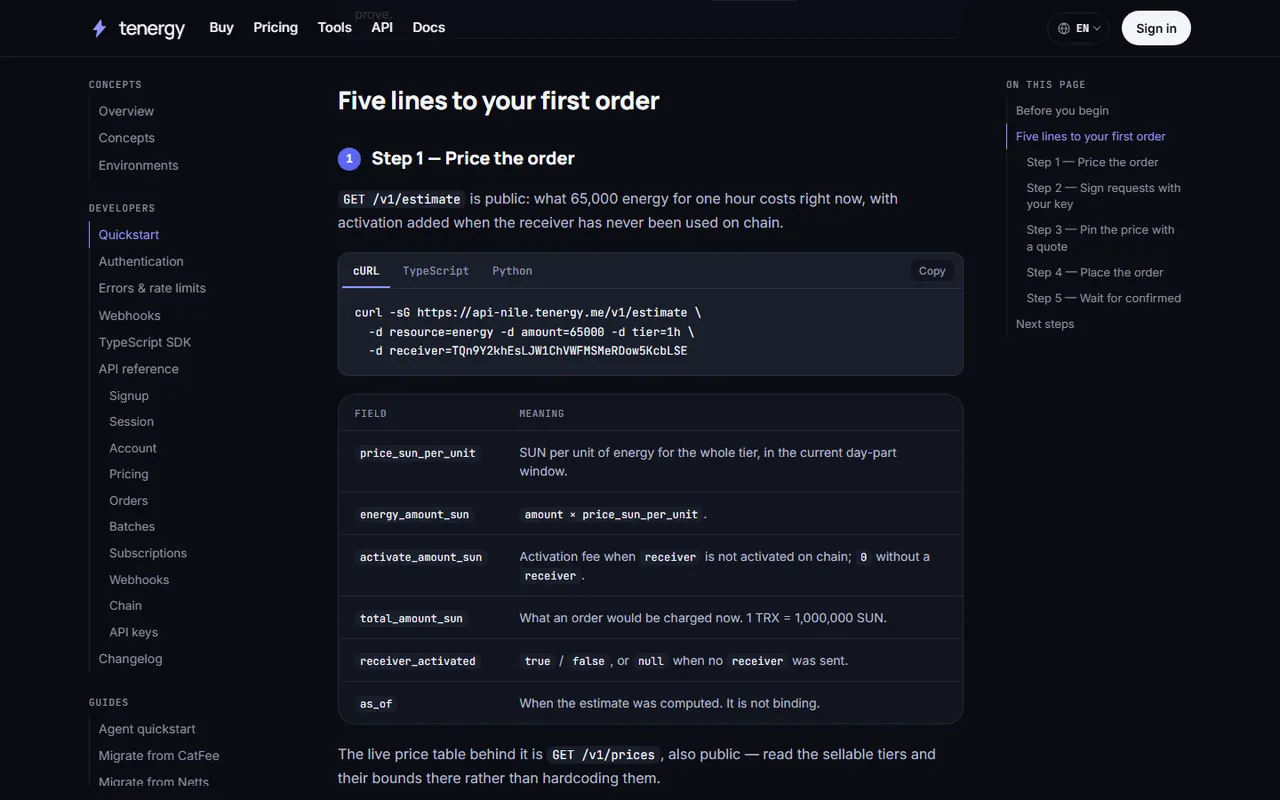
Machine-readable
| Document | What it is for |
|---|---|
| /openapi.yaml | The contract. Generate a client from it; it wins every divergence with prose. |
| /llms.txt | A curated map for an agent: what to read, in the order that gets it to a purchase. |
| /llms-full.txt | The whole corpus as one markdown file, for agents that prefer one fetch to twenty. |
| /.well-known/quickstart.json | The purchase flow as JSON: endpoints, auth, units, which steps need a human. |
| /docs/agent-quickstart | The operator prompt to paste into your own agent, with a copy button. |
| /docs/quickstart.md | Every docs page as markdown: add .md to its path. |
FAQ
How is a request authenticated?
Three headers: X-API-KEY, X-API-TIMESTAMP and X-API-SIGN, where the signature is base64(HMAC-SHA256(secret, timestamp + method + path + query + body)). The clock tolerance is five seconds.
Which permissions does a new key get?
Exactly the ones you choose. scopes is required, there is no default set and no preselected checkbox anywhere — in the contract, the dashboard or the agent flow.
Polling or webhooks?
Webhooks where you have a public HTTPS endpoint: we sign them and you verify. Polling GET /v1/orders/{id} is documented as the supported fallback, because many agent runtimes have no public URL.